

Prerequisites

Physical Cleanse

Mental Cleanse
Dissolve Blockers
Active State
"Do not begin this journey forcefully; make sure you are in a stable emotional state to reach the required level of attention."
Knowledge Retention

Show Mercy

Clean Environment

Clean Heart

Expectations

Journey of Observation
Exploring our own reality to find the purpose of existence through the anchors that keep us bound to reality.




Before You Begin This Journey
To fully engage with this exploration, please ensure you meet the following requirements:
15 Minutes of Undivided Attention
Find a quiet space free from distractions
Open Mind Without Biases
Willingness to consider new perspectives
Objective
Exploring our own reality to find the purpose of existence. Understanding the anchors which keep us bound to reality.
Additional Insights
- • Realizing The Need for Objective Morality
- • Traveler's Perspective
- • The Concept of Designer
The Need for Anchor Points

The Sailor's Journey
Imagine yourself sailing on a boat, with a heavy storm and no land in sight.
With every second your blood pressure increases due to fear and your mind races to find a solution to navigate in the right direction.
Stars, direction of sun and wind would be the solution; but first your mind must be at ease and your heart should be calm.
"Mindful Heart, Meaningful Life."
I will leave it up to your imagination to draw the parallels between your's and The Sailor's Journey but I want you to reflect on one important aspect: If stars, sun and wind are the solution for sailors sailing in storms, what is our solution in the Journey of Life?
Reflection Question
What are we going to look towards to find meaning, structure, and purpose in our life?
This question brings lots of things to mind like Philosophy, Religion, Government, Mindfulness, Discipline, Morality, Wealth, Influence, etc. Pause and ponder on this question in your alone time. If needed, write down what comes to mind, expand on it, read articles on it.
Personalities Variation
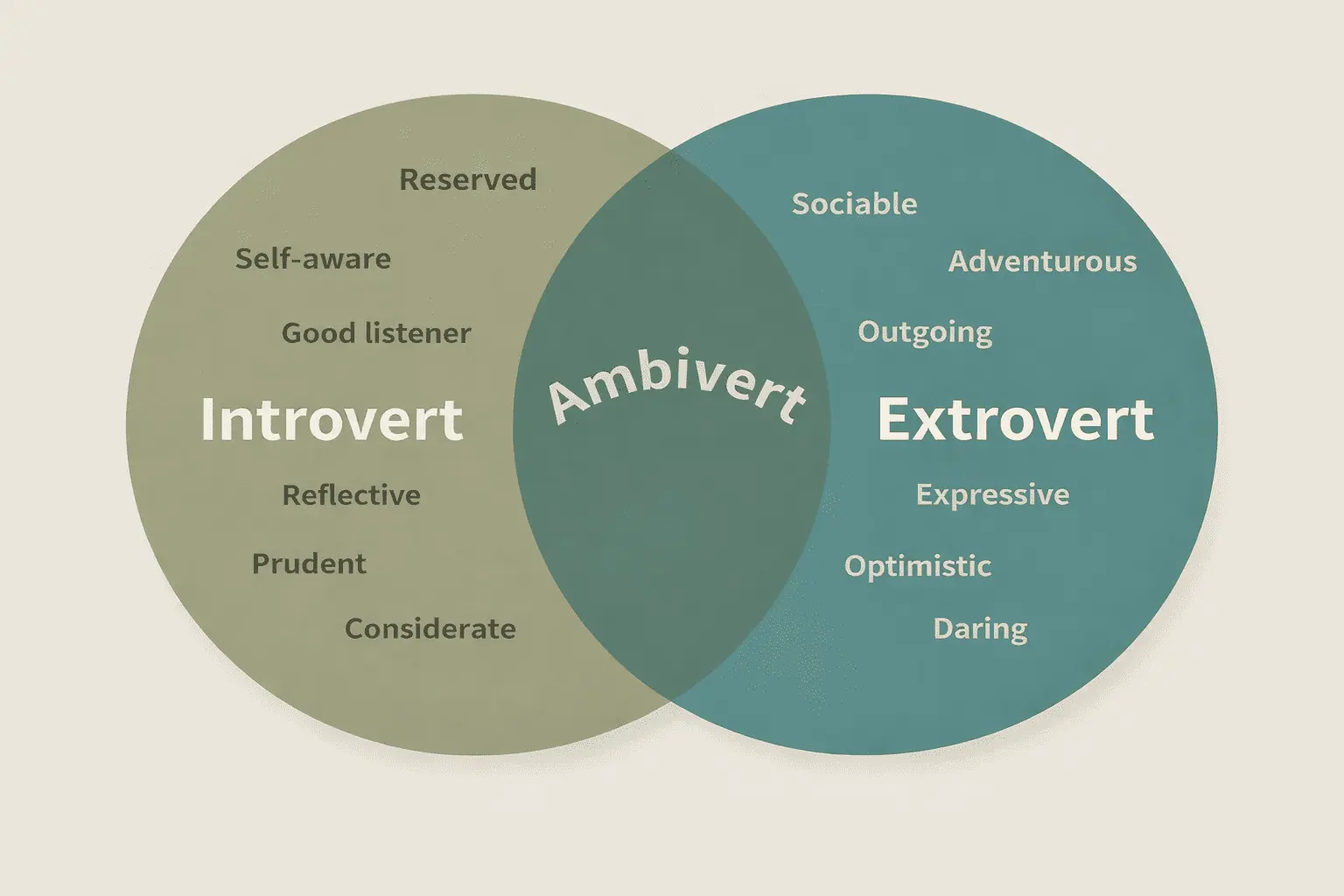
If you are an introvert or ambivert, you might have already done this and found yourself more confused than before.
If you are an extrovert, this might seem like a window you never felt like opening, but when you glanced at a beautiful sunset on a road trip or the lively waves on the seashore, the sight alone makes you question your existence.
This question exists in the heart of every mindful human. You might ask, What is the proof? Oxford-affiliated research strongly supports that meaning and purpose are central to human psychological well-being, be it the Worship of Wealth/power/influence or Worship of God or for a Just cause etc.
The 5-Minute Reflection
You will realize how Marketing agencies and ads are exploiting this fact.
You will ponder why there are so many religious people even in the 21st century, The Scientific era.
You will ask yourself: if one doesn't have any purpose in life, nothing will motivate them to wake up in the morning?
You will question the concept of Higher purpose and convince yourself that most people are too busy to think about it.
You will understand you yourself have become a target of these exploitations in one way or the other.
Cognitive Bias & Cognitive Dissonance
These biases often conflict with your actions and your innate dispositions, this feeling is called "Cognitive Dissonance".
Cognitive Bias
An umbrella term for a systematic pattern of deviation from rationality in judgment, in which individuals create their own "subjective reality" from their perception of input.
Cognitive Dissonance
The mental discomfort experienced when a person holds two or more conflicting beliefs, values, or attitudes, or when their behavior contradicts their beliefs.
"Tell him you disagree and he turns away. Show him facts or figures and he questions your sources. Appeal to logic and he fails to see your point."
Conclusion: The Sailor's Journey
The Sailor's journey was created as a thought experiment to reveal several essential insights:
- Logic and reason are powerful enough to help us understand the nature of our reality
- We all depend on anchors to find direction in the shifting tides of life
- Our perceptions are shaped by cognitive bias and cognitive dissonance
- True mental clarity emerges only when we confront the question of our own existence
The 5 Anchors
Building on top of our conclusions, we are going to establish the anchors which will ground us to reality so that we don't drift into a meta-physical realm or drown in our own subjective reality.
Here are some axioms (anchors to reality) which are inline with common-sense and logic. Humans from every corner of the world can resonate with it.
Birth
You had a beginning in this world. Like yourself, everything had a beginning in this Universe, and even the Universe itself had a beginning.
Death
You have limited time here and death cannot be avoided. Everything has an expiry date; you will also soon face this extinction.
Human Innate Disposition
Certain dispositions are present in every human being. Any rulings or laws against these dispositions simply cannot work.
Existence
You exist in this world, others also exist, this is not an illusion. Your intentions, actions, and goals have consequences.
Time
Time flows in one direction and it does not stop and it cannot be reversed. The limited nature of time reminds everyone about the expiry date.
First Anchor: Human Innate Dispositions
Everyone in this world has their own goals and objectives in life and are shaped as per their surroundings. We observe our surroundings using our 5 senses and those raw data is turned into information in our mind.
However, there are certain things that are common in all of us by birth and it is called Human Innate Dispositions.
10 Psychological Dispositions
15 Universal Moral Values
Maslow's Hierarchy of Needs
Physiological Needs
Fundamental biological requirements: air, water, food, warmth, sleep
Safety Needs
Personal security, freedom from fear, financial security, health
Love and Belonging
Friendship, intimacy, family bonds, sense of belonging
Esteem Needs
Self-respect, achievement, recognition, status
Self-Actualization
Fulfilling one's potential, personal growth, creativity
Reflection: Human Innate Dispositions
After understanding the concept of innate dispositions, it is clear that any purpose which we seek inherently cannot go against these dispositions.
Throughout history, if you observe any rule or constitution which had gone against these dispositions eventually resulted in a revolution.
The human innate disposition craves peace and stability above all else. This universal longing manifests itself in our desire for harmony in relationships, predictable social structures, freedom from fear, meaningful purpose, and connection with something greater than ourselves.
Second Anchor: Existence
Let us make this very simple: you as a person are real, and your actions matter. Claims like "we're in the Matrix" or "it's all a simulation" are interesting thought experiments which yield nothing but confusion.
Even if our universe was the most perfect simulation ever created, it makes no difference to your life.
The Rules are Real
The pain you feel is real. The love you share is real. Gravity is real. The physical rules of this world are consistent and inescapable.
Consequences are Real
Your goals, intentions, and actions have real, measurable consequences within this reality.
The Line of Existence
5-Minute Reflection on Existence
You will realize the beauty of chemistry and feel the power of nuclear force. Millions of chemical reactions are taking place in your brain right now.
You will ponder upon the beauty of our blue planet: its species, oceans, winds, the water cycle, the atmosphere, each working in sync.
You realize the vastness of space. The white dwarf, supernova, neutron star, or black hole reminds us of our sun's eventual fate.
You see that every field of science works together to reveal how extraordinarily complex our planet is.
You realize on a social level there is chaos filled with depression, wars, poverty, crimes, the one that impacts us most.
Reflection: Existence
We observed order and system on every part of The Line of Existence except on the human level. We ignored the big picture by focusing too much on the imperfections of humans.
The existence of design necessitates the existence of a designer.
Third Anchor: Time
Time is one of the most profound anchors of existence. Though modern science has revealed the relativistic nature of time, showing that it bends and shifts under the laws of physics, this should not diminish its significance in human life.
What is Time?
The progression of events from the past to the present into the future. If a system is unchanging, it is timeless.
Time Dilation
The time between events becomes longer the closer one travels to the speed of light. Moving clocks run more slowly than stationary clocks.
Arrow of Time
Time in the natural world has one direction: forward only. While physics equations work both ways, reality flows in one direction.
The Scale of Time
Facts About Your Time
Reflection: Time
The time we have is very limited and to find meaning to this short life is very much necessary when we are capable.
Birth and Death
Out of nothing (absolute nothingness) comes nothing. This universe also had a beginning and it definitely was created by something which was always existing, otherwise we end up in a loop of question "who created that creator? Who is the creator of that creator...", in other the words:The problem of Infinite Regress.
Nobody can deny death; it is the most certain thing for everyone. Similarly, the trend of entropy and other cosmological phenomena indicates the Universe also has an expiry date.
Pause & Ponder
on The 5 Anchors of Reality
Pause your reading for sometime and think about each of the 5 anchors we discussed. How it forms the basis of your existence.
Birth
Like yourself, everything had a beginning in this Universe, and even the Universe itself had a beginning.
Death
Everything has an expiry date; you will also soon face this extinction.
Human Innate Dispositions
There are some common needs among all human beings. The need for Objective Morality is felt very deeply.
Existence
The complexity and order in the Universe strongly hints at the existence of designer. The consitency and synchronization of the laws across the Universe strongly hints a single designer.
Time
The limited nature of time produces Cognitive Dissonance in mind to find meaningful purpose and direction.
"Life across species is rich with emotion and instinct, yet only humans have the ability to comprehend these 5 anchors of Reality."
The Need for Objective Morality
The question of finding our purpose in life cannot be explored until we understand our own reality deep enough to understand the purpose behind our existence.
Traveler's Perspective
A Thought Experiment
Imagine one day you wake up on a running train with no memory. Each traveler is enjoying their journey. What would be the first question that comes to your mind?
Instead of blending in with the travellers enjoying the journey or dwelling upon the working of the train, you will definitely try to get the answers to these questions.
The Concept of Designer
Looking closely at the anchors which are purely based on our reality: Two of the five anchors, the human innate disposition and existence, are hinting towards a designer of the system.
What do you mean by God?
All-powerful, all-knowledgeable, ever-existing, independent, and outside of space-time.
Do we need God to explain our existence?
Design requires a designer. Out of nothing comes nothing. Problem of infinite regression.
Can there be more than one God?
Multiple gods would lead to chaos, but we see stability. There cannot be two equally powerful entities.
Do logic and science align with God?
Each law and constant in any field of science implies the existence of a single designer behind it.
Where is God?
Since space-time is the creation of God, God is outside of it, for eaxample; a software developer cannot be inside the software.
Using our rationale and the anchors we had established earlier, following conclusions can be drawn:
"If we want objective morality untainted by human bias, who could be a better source than the Designer of the universe?"
Where We Stand
Now, we need to find the best ideology which has belief in God, strict monotheism, and provides a framework of objective morality which rids the chaos on "The Line of Existence".
Qualifying Metrics for Religion
We Now Have Clarity On:
Questions That Remain:
Begin Your Spiritual Journey
The process of dissolving your cognitive biases and solving the problem of Cognitive Dissonance has begun. Continue to convince your heart to such a level that you never lose sleep over finding the true purpose in life.
Continue the JourneySpiritual Journey
Exploring our own reality to find the purpose of existence through the anchors that keep us bound to reality.
Before You Begin This Journey
To fully engage with this exploration, please ensure you meet the following requirements:
Obsevational Journey
Complete Obsevational Journey to realize the need of objective morality.
20 Minutes of Undivided Attention
Find a quiet space free from distractions
Open Mind Without Biases
Willingness to consider new perspectives
Objective of this Journey
Journey Overview
This journey builds upon the foundations established in the Global Journey, taking you deeper into understanding divine guidance and its role in objective morality.
Preface
There are certain terms and concepts one must understand before reading any articles on theological concepts.
Three Fundamental laws of logic and rational thought:
5 Anchors of Reality (discussed in the Obsevational Journey)
Once we have an understanding of the above terms, we can dig deep into exploring the questions which were left unanswered in our previous Obsevational Journey.
Questions We Will Explore
Understanding Existence of God Through Reason
The Premise of Our Discussion
The foundation of our discussion rests on a simple yet profound premise: the best way to make sense of the world around us is through common sense and reason, these are the umbrella terms which has following concepts underneath:
Three Fundamental laws of logic and rational thought
The 5 Anchors which are justified by keeping Logic and rational thought as the basis.
Alternative methods people use are often subjective in nature. For Example:
The fundamental problem with these alternative methods is their subjective nature. Anyone can claim to have had a transformative spiritual experience or a compelling feeling, but these personal experiences can't serve as universal proof.
Now, I am going to make multiple claims keeping the above premise in mind.
Claims We Will Explore:
Natural Predisposition to Belief
According to Dr. Justin Barrett from Oxford's Centre for Anthropology and Mind, children have a natural predisposition to believe in a supreme being. His research suggests that even without religious teaching, children instinctively see the world as purposefully designed, making belief in God intuitive for young minds.
Research Evidence
Dr. Barrett's claims are based on psychological experiments that show children's innate tendency to attribute purpose and design to natural phenomena:
- Six and seven-year-olds believed birds existed "to make nice music" or "because it makes the world look nice".
- 12-month-old babies showed surprise when watching a ball apparently creating order from chaos
- By age four, children understand the difference between human-made objects and the natural world
- According to Barrett, this innate tendency makes children "more likely to believe in creationism rather than evolution," as evolutionary concepts are "unnatural for human minds; relatively difficult to believe."
This particular research is in line with the first of the five anchors we discussed: Human Innate Dispositions.
Reference: The Cognition, Religion and Theology Project
The Power of Common Sense
It is something that is universal and common! It's something we can all agree on, it's what people agree is the best thing to use to make decisions in their everyday lives and also by and large, it's objective, not subjective.
Scenario
Imagine this scenario: A man wearing nothing but underpants knocks on your door, claiming to be the electricity meter reader. How would you react? Would you:
If you apply the same logic to the complexity of our existence and observe the systems of our universe you conclude a designer behind the design.
The Design Argument
Consider your mobile phone. At its core, it's made of simple elements:
Now, imagine finding a mobile phone in the Arabian desert. Would you believe it formed naturally through wind blowing, sun shining, or lightning striking?
Of course not! The complexity of the phone's design and function points to a designer. Similarly, the universe's vast complexity and orderliness suggest a Creator.
Order in the Universe
The universe exhibits remarkable fine-tuning that makes life possible:
Earth's Perfect Rotation
Our planet rotates once every 24 hours. If a day was 30-40 years long:
- One side would be extremely hot
- Other side extremely cold
- Life would be nearly impossible
The Habitable Zone
Earth sits in the perfect position from the sun:
- Not too close (too hot)
- Not too far (too cold)
- Perfect for liquid water
If you observe carefully, you will find order and fine-tuning in many aspects of your day-to-day life. For example, the air you breathe contains the right amount of oxygen and nitrogen for humans to survive and for plants to thrive.
Inductive reasonings:
Following are the pointers which solidifies the existence of Intelligent Designer using some Logical philosophical concepts and inductive reasonings:
The Big Bang occurred approximately 13.5 billion years ago, which indicates that the universe had a definite beginning. A beginning suggests a cause that is not contained within the universe itself.
Infinite regress cannot account for real existence, because an endless chain of causes would never lead to anything coming into being. At some point there must be a reality that exists without being caused, one that possesses necessary existence.
The universe is contingent. It is composed of parts, depends on conditions, and could have been otherwise. What is contingent cannot explain its own existence, so it cannot serve as the necessary source of all reality.
Space is expanding, and the long term future of the universe points toward either a Big Freeze or a Big Crunch. Entropy continually increases, which implies that the universe is moving toward an endpoint. Anything that has both a beginning and an end cannot be self-existent.
Reasons given above are enough to understand the need for a Higher Power, but some people do have confirmation bias due to partial knowledge of philosophy.
If you are one of them, please dont skip the next 'Philosophical Journey'. If not skip skip to 'Religious Journey'.
The Nature of the Creator
Through our reasoning, we can deduce several key points about the nature of the Designer by observing the design:
Different from Creation
The Creator must be fundamentally different from the universe itself. For example, an artist cannot be on a canvas.
Uncreated
The Creator in discussion cannot have been created, or we would end with the problem infinite regress.
Self-sufficient
While creation is needy, the Creator to be a necessary existence must not rely on anything else for its existence.
Eternal
While creation is temporary and space-time is the also a creation, thus the Creator cannot be inside its own creation.
Unlimited
While creation is confined by space and time, the Creator must be free of these limitations.
Understanding God's Oneness
Why there Can Only Be One God?
Now that we've established that there must be a Creator, let's explore why there can only be one Creator and why this Creator must be different from everything in our universe.
We're going to use the same common sense approach to understand some important aspects about who God really is. These ideas aren't complicated, they're actually quite simple when we think about them step by step.
The Creator Is Not Like Creation
One of the first things we can figure out is that the Creator must be fundamentally different from the universe. Think of it this way, the artist is not the painting, the writer is not the book, and the inventor is not the invention.
Why the Creator must be different:
Remember our earlier reasoning, the universe needs a creator because:
- The universe couldn't come from nothing, you can't get something from nothing, especially something as vast and complex as our universe.
- The universe couldn't create itself, nothing can create itself before it exists!
Could the Universe Create Itself?
Think about this for a moment: how could the universe create itself? That would mean it existed before it existed to create itself! It's a logical impossibility.
The Phone Example Revisited:
Remember our mobile phone example? Would any rational person believe: "This phone assembled itself into a working device, organized all its components, wrote its own operating system, and designed its own features."
Of course not! We know complex, functional things require intelligent design.
Who Created the Creator?
This is where many people get stuck. They ask, "If everything needs a creator, then who created God?" It's a good question!
But here's the logic problem: If we say God was created by another creator, then who created that creator? And who created the creator of the creator? We'd end up in an endless loop, going back forever (The Problem of Infinite Regress).
The Table Lifting Example:
Imagine you want to lift a heavy table, but you can't do it alone:
Similarly, if every creator needs another creator, nothing would ever get created! But we know the universe exists as a result it is perfectly logical to infer that this chain of creators must have ended somewhere: The Uncreated Creator.
The Uncreated Creator
Using logical reasoning, we arrive at a sensible conclusion: There must be an uncreated Creator, one that wasn't made or designed but has always existed.
Qualities of the Uncreated Creator:
Why There Can Only Be One
Finally, we come to the question of God's oneness. If there were multiple creators, they would limit each other. Each would have boundaries where their power ends and another's begins. But this would make them limited beings, more like very powerful created beings rather than the unlimited Creator.
The Logic of Oneness:
An unlimited, self-sufficient, eternal Creator must be one because:
This is why we conclude there is One God, One Creator who designed this universe with perfect balance and harmony.
Search for The Ideology
Our next step is to find the ideology, which is inline with this aspect of God which we derived only through logical reasons.
Qualifying Metrics
Following were the qualifying metrics which were derived though 5 anchors of reality in the Obsevational Journey:
Let's list down each set of religions and briefly check its validity:
Prehistoric Religions
Prehistoric religions were the spiritual beliefs and practices of humans before written records, and they are studied through archaeological evidence like burial customs, cave paintings, and artifacts. Key features include animism (the belief that nature spirits inhabit animals and plants), elaborate funeral rituals suggesting beliefs in an afterlife, and the creation of symbolic art and monuments.
Criteria Check:
Ancient Egyptian Polytheism
Ancient Egyptian polytheism was a religious system involving the worship of multiple gods, such as Ra (sun god) and Osiris (god of the afterlife), each with their own domain and power.
Criteria Check:
Ancient Mesopotamian Polytheism
Ancient Mesopotamian polytheism was a religion with many gods and goddesses, each controlling different aspects of nature and human life.
Criteria Check:
Indus Valley Civilization Religion
The religion of the Indus Valley Civilization (IVC) is believed to have included the worship of a Mother Goddess, a male deity potentially linked to Shiva (seen on the Pashupati seal), and various forms of nature and animal worship, including trees, bulls, and mythical creatures.
Criteria Check:
Canaanite Religion
Canaanite religion(around the 15th to 13th centuries BC), was a polytheistic system of worship with a pantheon of gods, including the chief god El and the storm god Baal. It was connected to nature and fertility, and its practices involved rituals, sacrifices, and worship at temples and "high places". Key aspects included Festivals, Idol worship, Ritual prostitution, Child sacrifice
Criteria Check:
Vedic Religion
Vedic religion was an ancient Indo-Aryan religion from which modern Hinduism evolved, centered on the collection of sacred texts known as the Vedas. It was a polytheistic system that involved the worship of deities representing natural forces, through complex rituals, hymns, and sacrifices, including the use of a sacred drink called soma.
Criteria Check:
Buddhism and Jainism
Criteria Check:
Judaism
Criteria Check:
Christianity
Criteria Check:
Islam
Criteria Check:
Why Islam Stands Out
It is clear that all the Abrahamic religions are passing some of the criteria and Islam stands out because it fulfills all the criteria and its message unites all the Abrahamic religions. Among Abrahamic religion, Islam is very close to answering our questions because it is:
Looking at this line of reasoning and facts, this feels too good to be true. In the beginning of this Journey we had thought we had many options to choose from but upon contemplating on Our Nature, Our Existence and Our Biases , the options we thought we had were nothing but illusions.
Why Do We Need Divine Guidance?
Now that we've explored God's existence and oneness. Let's explore the necessity of revelation and why the Creator would communicate with us.
Think about it this way: if you created something amazing, wouldn't you want to explain how it works and what it's for? Let's explore why revelation and prophets make perfect sense.
A Creator Who Meets Our Every Need
On Observing "The line of existence", we noticed how perfectly our world is set up to meet our needs? It's quite remarkable.
Physical needs
We need food, water, and air to survive and they're all available to us.
Emotional needs
We're wired for love, friendship, and connection and we have the ability to form these relationships.
Intellectual needs
We're curious creatures with minds that crave knowledge and we live in a universe that can be explored and understood.
So here's a thought: If our Creator has provided for all these needs, wouldn't it make sense that He'd also provide for our spiritual and existential needs too?
Lets revisit the questions and expand on the same Big Questions we all ask:
Have you ever found yourself staring at the ceiling at night, wondering about the big questions in life? You're definitely not alone!
These aren't just random curiosities, they're deep and meaningful questions that shape how we live our lives. And now the answers to these questions can come only from the Creator of our whole existence.
Let's talk about something we all struggle with, the question of suffering.
Why do bad things happen to good people? Why is there pain in the world?
The Problem of Suffering:
When we think about suffering, it's important to remember a few things:
- The existence of suffering doesn't disprove God,we've already established logical reasons why God exists.
- This question is often more emotional than logical, it's about understanding, not proving.
- The only way to truly know the purpose behind suffering is if the Creator explains it to us.
This is just one example where human reasoning alone can't give us complete answers. Our minds are amazing, but limited. Just like a smartphone user needs the manufacturer's guide to fully understand all its features, we need guidance from our Creator to understand life's deepest aspects.
Why Would God Talk To Us?
Think about it, if you created something special, wouldn't you want to explain how it works? There are so many good reasons why God would communicate with us!
Why God would send revelation:
It makes perfect sense that God would want to communicate with us, not just to tell us He exists, but to help us understand who He is, what He wants from us, and how we can live in harmony with His design.
Why Prophets Make Perfect Sense
If God wants to communicate with humanity, what would be the most effective way? Through other humans who can explain, demonstrate, and relate to us!
Why prophets are the perfect messengers:
This is why the concept of prophets and divine revelation makes so much sense. Once we understand there is One Creator who designed everything with purpose, it's natural to conclude that this Creator would guide us through revelation and messengers.
Now after understanding the necessity of the Prophet and a divine message we can continue our journey.
What is Islam?
Definition:
The word "Islam" means "submission to the will of God".
Muslim:
A Muslim is someone who practices Islam and submits to the will of God.
Prophet:
Prophethood in Islam is the divine communication from God to humanity through chosen individuals called prophets or messengers. These prophets serve as intermediaries to convey God's message, guide people, and act as moral examples.
Scripture:
In Islam, scripture is understood as a direct, word-for-word revelation from God to his prophets, with the Quran being the final and complete one revealed to Prophet Muhammad (PBUH).
Quran:
The Quran is the final revealed message which complements and completes earlier revealed scriptures, just as the Prophet Muhammad (PBUH) taught the same essential message as the many prophets before him, including Adam, Noah, Moses, Abraham, and Jesus (peace be upon them all). The Quran clarifies what humanity needs to know from now until the Day of Judgment, and it will remain preserved from loss and distortion which affected previous scriptures in various ways.
Our objective research pointed us towards the existence of One God and it gave us logical criteria to filter out the ideologies. But from the perspective of a layman to understand why Islam would be the religion from God following points are enough:
In our journey, we assumed that God would certainly send us guidance. Let's explore how authentic that assumption truly is.
Why Islam Stands Out in the 21st Century
The religion of Islam standout of all the other religion even in 21st century because it:
Now, lets breakdown each one of the following Islam makes :
Claim #1
Muhammad(PBUH) was a Messenger of God.
Claim #2
Quran is a Divine Revelation
Muhammad(PBUH) was a Messenger of God
Explore the logical analysis of Prophet Muhammad's claim to prophethood
Understanding the Prophet's Claim
If you've already seen how the Quran is divine, this becomes simpler, because the Quran clearly states:
"Say, [O Muhammad], 'O mankind, indeed I am the Messenger of Allah to you all.'" [Quran 7:158]
But let's take a different approach too. When someone makes a big claim like being a prophet, there are only three possibilities to consider:
Possibility 1
The person is lying: He knew he wasn't a prophet but claimed to be one anyway.
Possibility 2
The person is mistaken: He genuinely thought he was a prophet but was confused or deluded.
Possibility 3
The person is truthful: He was actually chosen by God as a messenger.
Let's examine each possibility logically and think critically about this important question to see which one makes the most sense.
Was He Lying?
Let's look at what we know about Muhammad's character (PBUH), especially before he claimed to be a prophet. His reputation before prophethood:
- He was known as "Al-Sadiq Al-Amin" (The Truthful, The Trustworthy) among his people
- He avoided the common vices of his society (like idol worship, drinking, and gambling)
- He was known for caring for orphans, the elderly, and helping his community
- Even his enemies acknowledged his honesty!
The Abu Sufyan Incident
Abu Sufyan was a strong opponent of Muhammad ﷺ at the time. When he met Heraclius (the Roman Emperor), he was asked several questions about Muhammad ﷺ, including:
"Have you ever accused him of telling lies before his claim to be a prophet?"
Abu Sufyan answered: "No."
(Later, Abu Sufyan admitted, "If I had not been afraid of my companions labeling me a liar, I would not have spoken the truth about Muhammad ﷺ.")
Heraclius concluded: "I asked whether he was ever accused of telling lies before he said what he said, and your reply was in the negative. So I wondered how a person who does not tell a lie about others could ever tell a lie about God." (Recorded in Sahih Bukhari)
Let's also consider what people typically lie for:
What did he gain?
- Lived simply, not luxuriously
- Mended his own shoes and clothes
- Ate basic meals
- Left minimal possessions when he passed away
What did he endure?
- Persecution and mockery
- Social boycott for 3 years
- Physical attacks
- Forced exile from his hometown
He even refused generous offers to stop preaching. The leaders of Mecca once offered him wealth, women, and power if he would just stop spreading his message. He refused without hesitation.
When we consider all this evidence, the "he was lying" explanation starts to fall apart.
Was He Mistaken or Deluded?
Could Muhammad ﷺ have sincerely but mistakenly believed he was a prophet? Let's think about what this would mean:
What Muhammad ﷺ brought:
- A complete system for life: Including laws about family, economics, diet, hygiene, social relations, and spiritual practices. All still benefiting millions today.
- Accurate prophecies: Such as "barefooted bedouins competing in building tall buildings", which we see fulfilled today with skyscrapers in the Arabian Peninsula.
- Consistent character: He remained honest, humble, and principled throughout his life, never showing signs of mental instability.
The Solar Eclipse Incident
When Muhammad's ﷺ young son Ibrahim died, there happened to be a solar eclipse on the same day. Many people thought this was a divine sign mourning the death of the Prophet's son.
If Muhammad ﷺ was deluded or dishonest, this would have been a perfect opportunity to reinforce his claim to prophethood. Instead, he gathered people and said:
"The sun and the moon do not eclipse because of the death of someone from the people, but they are two signs amongst the signs of God. When you see them, stand up and pray."
Sahih al-Bukhari, Book 18, Number 154
He rejected the chance to use this coincidence for personal gain, instead teaching scientific accuracy and focusing on God alone.
When we consider the consistency, complexity, and lasting impact of his teachings, along with his rational behavior in moments where a deluded person would likely act differently, the claim that he was deluded or mistaken doesn't make any sense.
The Conclusion: He Was Truthful
When we've carefully examined the first two possibilities and found them inadequate to explain the historical facts, we're left with the third option: that Muhammad ﷺ was indeed telling the truth about being God's messenger.
Consider all the things we've discussed the evidence points to truth:
- His impeccable character: Known for honesty before and after prophethood, even by his enemies
- No personal benefit: He faced hardship and lived a simple life despite opportunities for wealth and power
- The coherence of his message: A comprehensive system that continues to benefit humanity
- His rational behavior: Even in situations where a liar or deluded person would likely act differently
- Fulfilled prophecies: Predictions that have come true long after his lifetime
The most reasonable conclusion, when we eliminate the alternatives, is that Muhammad ﷺ was indeed a messenger chosen by God to deliver divine guidance to humanity.
This perspective aligns with what the Quran says about him and explains why his message has had such a profound and lasting impact on human history.
A Messenger for Humanity
When we look at Muhammad's life ﷺ, his character, his message, and the impact he's had on history, the evidence points to the truth of his claim to be God's messenger.
His message was meant for all of humanity.
"And We have not sent you, [O Muhammad], except as a mercy to the worlds." [Quran 21:107]
By recognizing Muhammad ﷺ as God's messenger, we open ourselves to learning from his teachings and example. The guidance that has positively transformed countless lives throughout history and continues to do so today.
His life and character stand as a practical demonstration of the Quran's teachings in action, showing us how to implement divine guidance in our daily lives.
Quran is a Divine Revelation
Let's think about something we all do. When you buy a new phone or appliance, what's always included in the box? An instruction manual, right? It shows you how to use it properly, what to do and what not to do, and all the important warnings.
In a similar way, the muslims believe God has sent us an instruction manual for life called the Quran. It guides us on how to live, what to do and avoid, and gives us important warnings and recommendations for our journey through life.
But why should we believe the Quran is actually from God? Let's explore some really fascinating reasons that might surprise you!
Remarkably Preserved
One of the most amazing things about the Quran is how perfectly it's been preserved over 1,400 years.
The Quran itself makes a bold promise about this:
"It is certainly We Who have revealed the Reminder [the Quran], and it is certainly We Who will preserve it." [Quran 15:9]
This isn't just a claim, it's a reality you can verify yourself! You could pick up a copy of the Quran from anywhere in the world today and compare it with manuscripts dating back to within thirty years after Prophet Muhammad's time, and you'd find the text to be exactly the same.
Written preservation
Identical manuscripts exist from the earliest Islamic period, with careful systems to ensure accuracy.
Memorization
Millions of people worldwide, speaking countless languages, have memorized the entire Quran word for word, something not seen with any other book in history.
Impossible to Imitate
The Quran presents an interesting challenge to anyone who doubts its divine origin:
"And if you all are in doubt about what I have revealed to My servant, bring a single chapter like it, and call your witnesses besides God if you are truthful." [Quran 2:23]
This challenge is fascinating because the shortest chapter in the Quran is just three verses long (Surah al-Kawthar). How hard could it be to write three lines?
Well, the people who received this challenge were the Arabs of that time, master poets and linguistic experts who took immense pride in their language skills. Yet many of them embraced Islam just from hearing the Quran being recited. Despite their expertise, they couldn't meet this seemingly simple challenge.
The unique literary style of the Quran neither poetry nor prose but something entirely distinct continues to captivate listeners, even those who don't understand Arabic often find its recitation moving and powerful.
A Clear Message About God
Remember our earlier discussions about the nature of God? How does reason tell us there must be One Creator unlike creation? The Quran's description of God perfectly matches what we can understand through rational thinking:
How the Quran describes God:
A beautiful summary of this concept is found in the short chapter called Surah Al-Ikhlas:
"Say: He is God, the One and Alone,
God the one whom everything needs and who Himself needs nothing,
He is not born, nor does He beget,
and there is nothing that can be compared to Him."
A Message for Everyone
Another remarkable aspect of the Quran is its universal message. It's not meant for just one tribe, nation,race, gender or time period, it speaks to all of humanity across all ages.
The Quran's universal values:
These values aren't tied to any specific culture or time period: they're universal principles that make sense for creating a balanced, healthy society no matter where or when you live. Isn't it interesting that these align with what most of us already feel is right?
The Quran's Own Test of Authenticity
The Quran doesn't shy away from scrutiny. In fact, it offers its own test to determine if it's really from God:
"Do they not then consider the Quran carefully? Had it been from other than Allah, they would surely have found therein contradictions in abundance" [Quran 4:82]
This is a powerful challenge! The Quran was revealed over 23 years, addressing countless topics from theology to law, from personal conduct to cosmic events. For a human author to maintain perfect consistency across such a vast range of subjects over such a long period would be extremely difficult.
This challenge invites readers to examine the Quran critically, searching for contradictions or inconsistencies. This level of confidence suggests it knows it will pass such an examination.
Remarkable Accuracies
The Quran contains statements about history, science, and the natural world that are remarkably accurate, especially considering the time and place it was revealed.
Historical accuracies:
- Ancient Egyptian titles: The Quran correctly refers to the ruler in Joseph's time as a "King" but in Moses' time as "Pharaoh": matching what we now know from historical records.
- Multilayered descriptions: The Quran describes natural phenomena in ways that made sense to ancient audiences but also align with modern discoveries.
For example, consider how the Quran describes the origins of the universe:
"Do the disbelievers not realize that the heavens and earth were once one mass then We split them apart?"
For a 7th century audience, this description made sense, but for us today, it also aligns with our understanding of the universe beginning from a singularity (what scientists call the Big Bang).
Similarly, the Quran's description of embryonic development uses the Arabic word "alaqah"; which can mean a clinging substance, a leech-like structure, or a blood clot. When we look at an embryo around days 22-25, it does indeed resemble a leech and is clinging to the uterine wall!
A balanced view:
Remember, the Quran isn't meant to be a science textbook; it's a book of guidance. These fascinating alignments with modern knowledge are signs for reflection, not scientific claims. Science constantly evolves with new discoveries, while the Quran's purpose is to invite us to contemplate the Creator's wisdom and power.
Bringing It All Together
When we look at all these aspects together:
These qualities suggest that the Quran isn't just another book written by humans, but rather a divine revelation and our instruction manual for life from the Creator Himself.
Just as we would trust the manufacturer's guide to show us how to use our devices properly, the Quran offers guidance on how to live our lives in accordance with our Creator's wisdom and purpose.
Answering the Questions asked in the beginning of this Journey:
What is the correlation between religion and Objective Morality?
Answer: Any ruling designed by us humans will have some biases and prejudice in it. For example,a rich person will favour the ruling which grows his wealth. Each person has their own biases as per their attributes like their upbringing, their gender, their race, their age, their problems in life, their family, their reputation, their goals etc. and this is the primary reason why a mere human being cannot come up with a system which is applicable to all living things on earth. For Objective Morality to be valid and "Objective" in the real sense it must come from an external entity which is not affected by the biases of Humans.
How does the existence of God make sense to a rational mind?
Answer: The existence of the Universe is enough for a rational mind to understand that a design requires a designer.
How do these concepts help anyone in finding the true purpose of life?
Answer: One of the purposes of religion itself is to provide a stable way of life to human beings but religions have always been used to control and subjugate the masses. A correct religion gives us the clear distinction between right and wrong. To find the correct religion these line of reasonings and logical proof are very much needed.
Can you summarize the whole spritual journey?
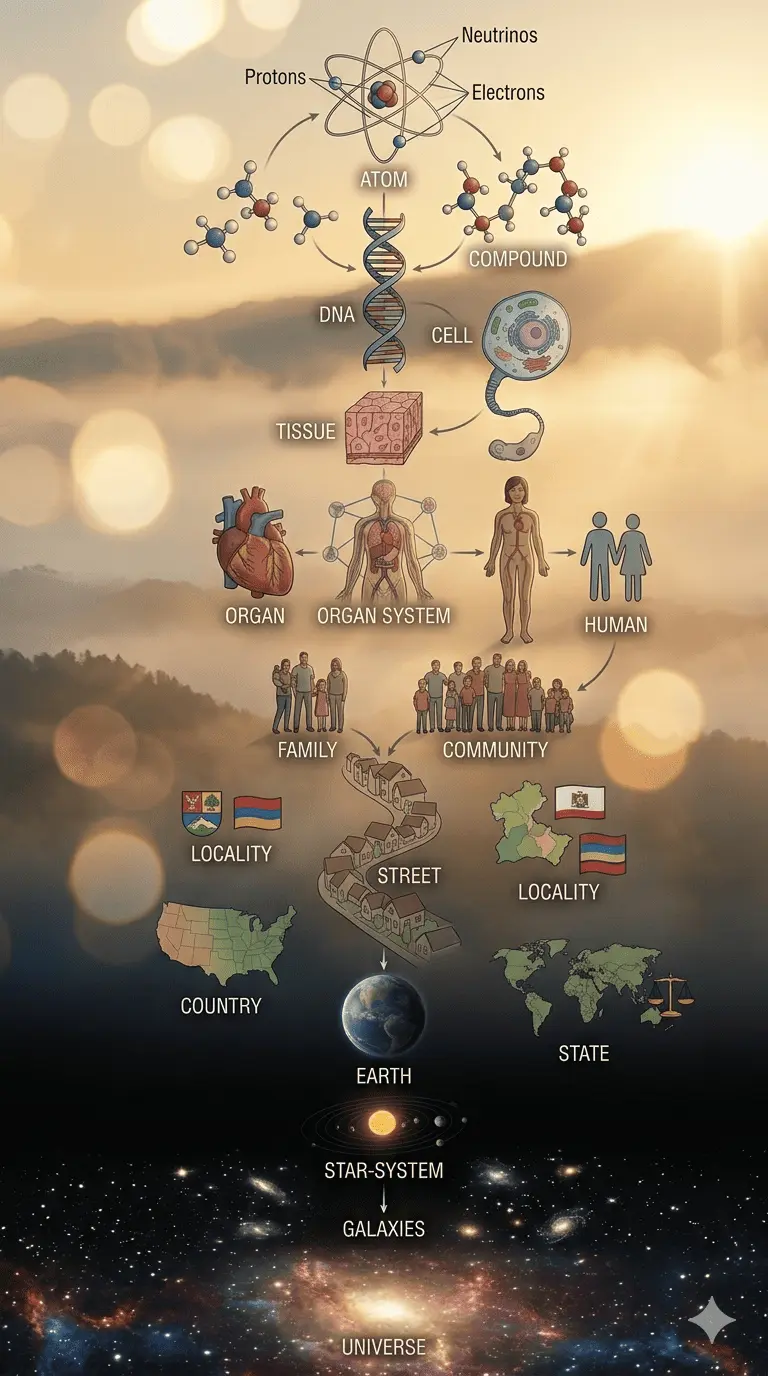
Answer: Observing the creation => Contemplating on the complexity of the design=> trying to find the designer behind this beautiful design(Universe atom->galaxies) => Existence of God => Oneness of God(Understanding Logical proof and Inductive reasoning behind it) => Brief comparative religion study=> Finding truly monotheistic religion => finding Islam=> Exploring prophecies of prophet Muhammad PBUH and Scientific miracles in Quran => understanding islam => developing Imaan in the heart => Understanding their own Nafs, purifying it and keep fighting with their nafs , shaitan and surrounding => executing all actions(worship and daily activities) with Ihsaan in their life
What is the true purpose of our Life?
Answer: Now that we have clarity on many aspects of Life and we have found the true religion to be Islam. Lets see what purpose does Islam give to its adherents:
To a Muslim the whole purpose of life is "ibadah" or worship to the One True Almighty God on His Terms and under His Conditions.
The term "worship" to a Muslim includes any and all acts of obedience to Almighty Allah. So his purpose of life is a standing purpose; Worshipping Allah by accepting Allah's Will over his own. This act of ibadah [worshipping, thanking and extolling the Greatness Almighty Allah on His Terms and Conditions] is for the Muslim, throughout his whole life regardless of the stage. Whether he is a child, adolescent, adult or aged person, he is seeking after the Will of the Almighty in all these stages.
His life here on earth, although short, is full of purpose and is totally meaningful within the complete framework of total submission [Islam].
Similarly, in the Next Life as well, his faith, intentions, attitudes and good deeds will all be weighed into his account as favorable, putting him in high esteem with his Creator and Sustainer. Because Islam teaches that this life is only a test or trial for the individual to show him his true nature, it is only natural that he would accept death as not so much an ending to everything but more as a beginning of the final and lasting life in the Hereafter.
Before entering into either of the final lodging places i.e.; Heaven or Hell, there must be a Day of Judgment or showing of one's true self to make them aware of their own nature and thereby understand what they have sent on ahead during their life here on this earth. Every person will be rewarded [or punished] according to their attitude, appreciation and efforts during this stay on earth.
None will be asked about the actions and beliefs of others, nor will anyone be asked regarding that which he was unaware of or incapable of doing.
Reward and punishment will be in direct proportion to each person and it is only Allah, alone who will be the Final Judge over us all.
Notice how Islam solves the mystery of the puzzle of life. It provides the answers to the questions and concerns of human beings on all levels and in every aspect. It is simple and easy to understand.
Conclusion
In Obsevational Journey, we concluded the need for Objective Morality.
Once again, we took the Top-Down approach to find the objective morality without any biases. This is the sequence:
Understanding the strong anchors which keeps us tied to the reality (Obsevational Journey)
The Need for Objective Morality (Obsevational Journey)
Understanding the concept of God
Proving the Existence of God
Proving the oneness of God
Understanding the necessity of Divine Guidance
Established a logical criteria to filter out the right ideology
Finding Islam to be the religion which is in line with the definition of God,Oneness of God and is compliant with The Anchors of Reality.
By now, you must have conviction that Islam is the religion which provides Objective Morality on every level of The Line of Existence and gives every human a true purpose and meaning to their life. You can begin your Religious journey which answers all the Questions we asked in the beginning of our observation.
To truly understand the purpose of your life, start your Religious Journey.
The process of dissolving your cognitive biases and solving the problem of Cognitive Dissonance has begun. Continue to convince your heart to such a level that you never lose sleep over finding the true purpose in life.
If not convinced regarding the existence of God, continue with Philosophocal Journey else skip to Religious Journey.
Philosophical Perspective: Proofs for God's Existence
Before You Begin This Journey
To fully engage with this exploration, please ensure you meet the following requirements:
5 Minutes of Undivided Attention
Find a quiet space free from distractions
Open Mind Without Biases
Willingness to consider new perspectives
Objective
We'll explore five key proofs that point toward the existence of a necessary, independent Creator, followed by three arguments for why this Creator must be One. These proofs build upon common sense and logical reasoning that we use in our everyday lives.
Preface
There are certain terms and concepts one must understand before reading any articles on theological concepts.
Three Fundamental laws of logic and rational thought:
5 Anchors of Reality (discussed in the Obsevational Journey)
Five Logical Proofs
These proofs and arguments collectively point to the existence of a single, necessary, and independent Creator who is the foundation of all existence.
Everything that exists is either dependent or independent. Dependent things rely on something else for their existence and cannot sustain themselves indefinitely. If everything were dependent, there would be no foundation for existence, making the presence of an independent existence necessary.
Core Reasoning:
- Premise: Everything composed of parts is dependent, as its existence relies on the arrangement and interaction of its components.
- Logical Extension: The universe, being composed of countless interacting parts, must also be dependent.
- Conclusion: A dependent universe or even an infinite multiverse requires an independent existence to serve as its foundation.
Key Terms:
Dependent Existence: An entity that requires something else to sustain its existence.
Independent Existence: A necessary, self-sufficient existence that underlies all dependent entities.
The most fundamental reality is that existence is undeniable and there is no doubt that something exists. This foundational truth is more basic than any fact, including necessary facts such as mathematical truths. Even statements like "2 + 2 = 4" presuppose the existence of something that allows these truths to hold meaning.
Core Reasoning:
- Premise: Existence is presupposed in everything real, including necessary facts.
- Reasoning: Necessary facts are unchangeable and absolute, yet their truth depends on the existence of reality itself.
- Conclusion: Since necessary facts presuppose existence, they ultimately depend on it, affirming that existence is the most fundamental category.
Key Terms:
Existence: The most fundamental reality, which is undeniable and independent of any fact.
Necessary truths: Facts that are true in every possible circumstance but presuppose the existence of reality.
If something could have been arranged differently in an abstract sense, then its current arrangement must be the result of some external factor rather than necessity. The universe, as we observe it, could have been arranged in countless other ways. Therefore, its specific configuration must be attributed to an external arranger, rather than being necessary in itself.
Core Reasoning:
- Premise: Anything that could be conceived in a different way must have been arranged by something external to it.
- Reasoning: Since the universe could have had an alternate structure, its current arrangement must be due to a deliberate act of arrangement.
- Conclusion: This arranger must be independent and necessary in itself, meaning it is not contingent on anything else.
Illustrative Analogy:
Imagine a set of letters, A, B, and C, that can be rearranged in different ways. If one specific order exists, it must have been chosen by something. Likewise, the universe's specific structure, which could have been different, suggests it was arranged by an external, independent being.
Scientists have discovered that the physical constants and laws of our universe are finely tuned to allow life to exist. Even tiny changes to these values would make life impossible.
Core Reasoning:
- Premise: The laws of physics, constants of nature, and stability of the universe are set at precise values that allow life to thrive.
- Reasoning: Whether this fine-tuning is necessary or contingent, it requires an explanation from a foundation that is not itself contingent.
- Conclusion: The finely tuned nature of the universe suggests the presence of an underlying, purposeful cause, an independent and necessary entity.
Key Terms:
Contingent: Something that depends on certain conditions or could be otherwise.
Fine-tuning: The precise calibration of physical constants and laws that make our universe capable of supporting life.
Everything composed of multiple parts, from smartphones to living organisms to galaxies, must have been caused by something else. The universe itself, being composite, requires an external cause.
Core Reasoning:
- Premise: Just as a car is assembled from many parts, the universe is composed of various elements.
- Reasoning: Since every composite thing is caused by how its parts are arranged, the universe too must have been caused.
- Conclusion: This cause must be an independent being that is self-sufficient and necessary, not caused by anything else.
Real-World Example:
Consider your smartphone. It's made of various components that someone assembled in a specific way. It didn't assemble itself! Similarly, the universe, with its billions of galaxies, stars, and planets, must have been caused by something beyond itself.
Oneness of God
Now that we've established the existence of a necessary Creator, let's explore why this Creator must be One.
A necessary existence, by its very nature, cannot vary or have alternatives. It must be exactly as it is in every possible scenario.
Core Reasoning:
- Premise: If something is truly necessary, it must exist exactly as it is in every possible scenario.
- Reasoning: If there were two or more necessary beings, each would have some distinguishing feature. But any difference would mean one could have been otherwise, contradicting the idea of necessity.
- Conclusion: There can only be one unique necessary existence.
The necessary existence is responsible for everything else, so it must have unlimited power or capacity over all things.
Core Reasoning:
- Premise: An entity that is the cause of all that exists must hold ultimate authority or capacity over the entire cosmos.
- Reasoning: If this capacity were shared between multiple entities, none could claim full responsibility for creation and maintenance of all things.
- Conclusion: The necessary existence must be unique in its capacity, it is the only one that holds ultimate control.
Real-World Example:
Consider a national government. It works most effectively when there's a single, central authority rather than competing powers. Similarly, the universe's perfect coordination suggests a single source of ultimate authority.
The consistent order, stability, and regularity we observe in nature point to one organizing agent rather than many competing forces.
Core Reasoning:
- Premise: Nature exhibits remarkable stability, regularity, and uniformity across different contexts.
- Reasoning: For such consistent order to exist, there must be a single, unified source arranging the natural world. Multiple competing agents would likely result in chaos or inconsistency.
- Conclusion: The natural world's ordered structure is best explained by one unique, necessary being acting as the sole arranger.
Real-World Example:
The laws of physics work the same way throughout the universe. Gravity behaves consistently whether on Earth or in distant galaxies. This universal consistency suggests a single source of order rather than multiple creators with different approaches.
One Necessary Creator
These proofs and arguments lead us to a conclusion: there must be One unique, necessary, and independent Creator behind our universe.
What We've Discovered:
These logical proofs don't just suggest the existence of a Creator, they point to specific attributes this Creator must have: independence, necessity, and oneness. These align remarkably well with what many religious traditions have taught about God for thousands of years.
Whether you approach these arguments from a philosophical, scientific, or theological perspective, they invite us to consider the profound implications of a universe that points beyond itself to One necessary Creator.
Continue the JourneyBefore You Begin This Journey
To fully engage with this exploration and derive maximum benefit, please ensure you meet the following requirements:
Spiritual Journey
Complete Obsevational Journey to understand 5 anchors of reality and the need of Objective morality.
Complete the Spiritual Journey
Complete the Spiritual Journey to understand how Islam fulfills the need of Objective morality and is aligned with the 5 anchors of reality.
10 Minutes of Undivided Attention
Find a quiet space free from distractions
Objective of this Journey
Understanding Islam: Discover the core teachings, history, and beauty of Islam through this comprehensive guide.
The Sweetness of Imaan: Discovering the profound joy and fulfillment that comes from true faith
Ihsaan: The Three Dimensions of Faith: Discover the beautiful harmony of Iman (Faith), Islam (Submission), and Ihsan (Excellence)
Finally get the Answers to questions we asked in Obsevational Journey.
What is a Religion?
In the field of comparative religion, some of the characteristics of religion take into consideration are following:
Since we are discussing the religion of Islam, lets dive into each one the characteristic of the religion.
Understanding Islam
What is Islam?
The meaning of the word Islam is: submission, humbling oneself, and obeying commands and heeding prohibitions without objection, sincerely worshipping Allah alone, believing what He tells us and having faith in Him. And, everyone who acquires this attribute is called a Muslim.
All the religions on earth are called by various names, either the name of a specific man or a specific nation. So Christianity takes its name from Christ; Buddhism takes its name from its founder, the Buddha; the Zoroastrians became well known by this name because their founder and standard-bearer was Zoroaster. Similarly, Judaism took its name from a tribe known as Yehudah (Judah), so it became known as Judaism. And so on.
Except for Islam; for it is not attributed to any specific man or to any specific nation, rather its name refers to the meaning of the word Islam. What this name indicates is that the establishment and founding of this religion was not the work of one particular man and that it is not only for one particular nation to the exclusion of all others. Rather its aim is to give the attribute implied by the word Islam to all the peoples of the earth.
Clearing Up Major Misconceptions
Before diving into what Islam is, let's address some common misunderstandings that might be clouding your view:
Misconception: Islam promotes violence
Reality:
Islam places enormous emphasis on peace, compassion, and the sanctity of life. The Quran states: "Whoever kills a person... it is as if he has killed all of mankind, and whoever saves a life, it is as if he has saved all of mankind." (5:32)
Misconception: Islam oppresses women
Reality:
Islam elevated women's status in the 7th century by giving them the right to education, property ownership, inheritance, divorce, and participation in public life. The current situation in some Muslim-majority countries often reflects cultural practices rather than Islamic teachings.
Misconception: Islam is just for Arabs
Reality:
Only about 20% of Muslims worldwide are Arabs. The largest Muslim populations are in Indonesia, Pakistan, India, and Bangladesh. Islam embraces all ethnicities and backgrounds - the Quran states: "We have made you into nations and tribes so that you may know one another" (49:13).
Misconception: Islam is rigid and unchanging
Reality:
While core beliefs remain constant, Islamic scholarship has a rich tradition of interpretation and adaptation to different times and places. The concept of ijtihad (reasoned interpretation) allows for flexibility in applying principles to new situations.
It's important to distinguish between the teachings of Islam and the actions of some individuals or cultural practices that may contradict those teachings. Just as we wouldn't judge any field of study by some of its students, we should approach Islam by examining its actual principles and teachings.
The Five Pillars: Islam's Foundation
Islam is built on five core practices that shape a Muslim's life. These Five Pillars provide the structure that helps Muslims maintain their faith and live out its principles:
Shahada (Declaration of Faith)
The testimony: There is no god but God, and Muhammad is the messenger of God.
This simple statement is the foundation of Islamic belief - acknowledging One God and accepting Muhammad as His prophet. It's not just words though - it's a commitment to live by these beliefs.
Salah (Prayer)
Five daily prayers at dawn, noon, afternoon, sunset, and evening.
Think of prayer as a regular check-in with God - it helps Muslims stay mindful and connected throughout their day. Each prayer takes just a few minutes and involves physical postures that engage the body, mind, and spirit. It's like pressing a reset button five times a day!
Zakat (Charitable Giving)
Annual donation of 2.5% of one's savings to those in need.
Zakat isn't just charity - it's a recognition that wealth is a blessing from God that comes with responsibility. By giving a portion to those in need, Muslims purify their wealth and help create a more equitable society where everyone's basic needs are met.
Sawm (Fasting)
Abstaining from food, drink, and other physical needs from dawn to sunset during Ramadan (the 9th month of the Islamic calendar).
Fasting teaches self-discipline and empathy for those less fortunate. It's also a time of increased prayer, charity, and community. Many Muslims describe Ramadan as a spiritual tune-up that helps them reset their priorities and strengthen their connection with God.
Hajj (Pilgrimage)
Journey to Mecca once in a lifetime for those who are physically and financially able.
Hajj is the ultimate spiritual journey where over 2 million Muslims from all walks of life gather in Mecca wearing simple white garments that erase distinctions of class, wealth, and status. It commemorates the experiences of Prophet Abraham and his family and represents the unity of believers before God.
These pillars aren't meant to be burdensome rituals but practices that enrich life and foster a continuous connection with God. They balance personal spiritual growth with social responsibility, helping Muslims develop both as individuals and as contributing members of their communities.
Pure Monotheism: The Essence of Islam
At the very heart of Islam is a crystal-clear concept of God - a pure monotheism that's often described as the most uncompromising form of belief in One God.
"Say: He is Allah, the One and Only; Allah, the Eternal, Absolute; He begets not, nor is He begotten; And there is none like unto Him." [Quran 112:1-4]
Key aspects of Islamic monotheism:
Absolute Oneness
God is One without partners, associates, or equals. Nothing shares in God's nature or attributes.
No physical form
God is not material and cannot be represented by images or idols. "Vision cannot grasp Him, but He grasps all vision." [Quran 6:103]
Direct relationship
Every person has direct access to God without intermediaries. "When My servants ask you about Me, indeed I am near. I respond to the call of the caller when they call upon Me." [Quran 2:186]
Creator not creation
God is entirely separate from creation - not a person, not incarnated in human form, and not part of the universe.
This understanding of God isn't abstract theology - it shapes how Muslims approach life. When you believe that there is only One Ultimate Reality worthy of worship, your focus and priorities become clearer.
The Islamic concept of monotheism also means that nothing in the creation - not wealth, career, desires, or even religious figures - should be elevated to a position that only God deserves.
Core Beliefs: The Articles of Faith
Beyond the Five Pillars that shape daily practice, Islam has six fundamental beliefs that form its theological foundation. These Articles of Faith provide the worldview through which Muslims understand existence:
Belief in One God (Allah): The absolute oneness of God (Tawhid) is the central pillar of Islamic faith. God is the Creator, Sustainer, and Master of the universe.
Belief in Angels: Muslims believe in beings created from light who carry out God's commands and never disobey Him.
Belief in Divine Books: Muslims believe God revealed books to various prophets as guidance for humanity, with the Quran being the final revelation.
Belief in Prophets: Muslims believe God sent prophets to every nation throughout history to guide people to truth.
Belief in the Day of Judgment: Muslims believe this life is a test and that one day everyone will be resurrected and held accountable.
Belief in Divine Decree: Muslims believe God has knowledge of everything while humans have free will and are responsible for their choices.
Islam: The Fastest Growing Religion
Did you know that Islam is the fastest-growing religion in the world?
This isn't just about numbers; it's about people finding meaning, purpose, and peace in its teachings.
Why Islam Resonates:
- Clear Guidance: In a world full of confusion, Islam offers a straightforward path to living a meaningful life.
- Strong Community: The sense of belonging and brotherhood/sisterhood in Islam attracts many to its fold.
- Spiritual Fulfillment: The balance between worship, work, and relationships provides a holistic approach to life.
- Logical Faith: Islam encourages questioning and reasoning, making it appealing to those seeking intellectual satisfaction.
Whether through personal reflection, the example of Muslim friends, or simply reading the Quran, millions are discovering the beauty of Islam every year. It's a testament to the timeless relevance of its message.
Discovering Islam for Yourself
Islam is a vast ocean of wisdom, and the best way to understand it is to dive in yourself. Whether you're curious about its teachings, inspired by its history, or seeking answers to life's big questions, Islam has something to offer.
Remember, Islam isn't about blind faith. It's about seeking truth with an open heart and mind. As the Quran says: "So have they not traveled through the earth and have hearts by which to reason and ears by which to hear?" [Quran 22:46]
If you're interested in learning more, start by reading the Quran, visiting a local mosque, or talking to Muslims in your community. You might just find the peace and purpose you've been looking for.
Becoming a Muslim
For anyone to become a Muslim (the one who submits his will to God), he/she has to truly believe in One True God and Prophet Muhammad (PBUH) to be a prophet from God. Then, one has to declare it by tongue.
The declaration goes as follows:
أَشْهَدُ أَنْ لَا إِلَٰهَ إِلَّا ٱللَّٰهُ وَحْدَهُ لَا شَرِيكَ لَهُ، وَأَشْهَدُ أَنَّ مُحَمَّدًا عَبْدُهُ وَرَسُولُهُ
Transliteration: ashhadu alla ilaha illallah wahdahu la sharika lahu lahu wa-ash-hadu anna Muhammadan abduhoo wa rasooluhu.
Translation: "I bear witness that there is none worthy of worship except Allah, the One alone, without partner, and I bear witness that Muhammad is His servant and Messenger"
Note: In Islam, a person must sincerely believe in one God and in Prophet Muhammad ﷺ as the Messenger. This requirement removes any possibility of forced conversions. The Qur'an also states that there is no compulsion in religion:
لَآ إِكْرَاهَ فِى ٱلدِّينِ ۖ قَد تَّبَيَّنَ ٱلرُّشْدُ مِنَ ٱلْغَىِّ ۚ فَمَن يَكْفُرْ بِٱلطَّـٰغُوتِ وَيُؤْمِنۢ بِٱللَّهِ فَقَدِ ٱسْتَمْسَكَ بِٱلْعُرْوَةِ ٱلْوُثْقَىٰ لَا ٱنفِصَامَ لَهَا ۗ وَٱللَّهُ سَمِيعٌ عَلِيمٌ ٢٥٦
There is no compulsion in Faith. The correct way has become distinct from the erroneous. Now, whoever rejects the Tāghūt (the Rebel, the Satan) and believes in Allah has a firm grasp on the strongest ring that never breaks. Allah is All-Hearing, All-Knowing.
[Quran 2:256]
The Sweetness of Imaan
Imaan is the second level of the Religion of Allah. It means firm belief and consists of three basic aspects: conviction with the heart, proclamation with the tongue, and action with the limbs.
The Six Pillars of Faith
Iman means believing in:
Allah: His existence, oneness of His Lordship, worship, and uniqueness of His names and attributes
His Angels: Created from light, who never disobey Allah
His Books: All revelations, especially the four mentioned in the Quran
His Messengers: Chosen from mankind to call to Allah
The Last Day: Resurrection, judgment, rewards, and punishments
Divine Decree: The good and ill of fate, predetermined by Allah's knowledge and will
The Three Dimensions of Faith
Conviction with the heart: Firm belief and certainty without doubt
Proclamation with the tongue: Verbally declaring one's faith
Action with the limbs: Practicing faith through deeds and worship
Imaan increases with obedience and decreases with disobedience.
The Prophet Muhammad ﷺ said faith has over 60 branches, including both your heart's belief and your physical actions. The core of faith is believing there's no god worthy of worship except Allah.
Iman in Tough Times
"Faith wears out in the heart just like clothes wear out - so renew your faith."
Faith is like a tree that needs constant care. We need to water our faith with knowledge, good deeds, and remembrance of Allah.
Care for Your Faith
We need to water our faith with knowledge, good deeds, and remembrance of Allah. We also need to protect it from "pests" - sins, desires, and doubts.
Relativity of Rewards
The Prophet ﷺ said those who do good deeds during difficult times will get the reward of fifty people! Staying strong during tests brings greater rewards.
Why Faith Fades
The Root Cause
The main reason people leave Islam is that the essence of faith never truly entered their hearts to begin with.
Once faith truly merges with your heart, you'll never want to give it up. Faith has a sweetness - once you taste it, nothing else compares! But if you've never tasted this sweetness, you won't realize what you're missing.
Many people practice Islam only through external actions without understanding the inner beauty. Their worship becomes just rituals without a real connection to Allah.
The Sweet Taste of Faith
One of Allah's greatest gifts is making faith beloved to us, adorning our hearts with its beauty, and letting us taste its sweetness.
"Faith has a flavor and sweetness that is tasted by the heart just like the sweetness of food and drink is tasted by the mouth. Faith is food for the heart, just as food and drink nourish the body."
Finding Joy in Good
The sweetness of faith means finding joy in doing good deeds and even in facing difficulties for Allah's sake.
Experience It Yourself
You can read about this sweetness all you want, but you won't truly understand until you experience it!
Barriers to Sweetness
Think of it like being sick. When you're feeling nauseous, even the most delicious meal doesn't appeal to you. Similarly, when our hearts are "sick" from sins and desires, we can't enjoy the sweetness of faith.
"If you want to find the sweetness of worship, put an iron wall between yourself and worldly desires."
Sins prevent us from tasting the sweetness of faith. The more pleasure we find in sinning, the less joy we find in worshipping Allah.
Finding the Sweetness
The sweetness of faith comes from worshipping Allah completely - combining outer actions with inner feelings. Here's how to taste this sweetness, according to the Prophet Muhammad ﷺ:
Seven Ways to Taste the Sweetness of Faith:
Love Allah and His Messenger ﷺ more than anything else in this world.
Surah At-Tawbah 9:24
قُلْ إِن كَانَ آبَاؤُكُمْ وَأَبْنَاؤُكُمْ وَإِخْوَانُكُمْ وَأَزْوَاجُكُمْ وَعَشِيرَتُكُمْ وَأَمْوَالٌ اقْتَرَفْتُمُوهَا وَتِجَارَةٌ تَخْشَوْنَ كَسَادَهَا وَمَسَاكِنُ تَرْضَوْنَهَا أَحَبَّ إِلَيْكُم مِّنَ اللَّهِ وَرَسُولِهِ وَجِهَادٍ فِي سَبِيلِهِ فَتَرَبَّصُوا حَتَّىٰ يَأْتِيَ اللَّهُ بِأَمْرِهِ ۗ وَاللَّهُ لَا يَهْدِي الْقَوْمَ الْفَاسِقِينَ
Say, “If your fathers and your sons and your brothers and your spouses and your clan and the wealth you have earned and the trade you apprehend will recede and the homes you like are dearer to you than Allah and His Messenger and Jihād in His way, then, wait until Allah comes with His command. Allah does not lead the sinning people to the right path.”
Love others purely for Allah's sake, not for personal gain or worldly benefit.
Surah Al-Insan 76:8–9
وَيُطْعِمُونَ الطَّعَامَ عَلَىٰ حُبِّهِ مِسْكِينًا وَيَتِيمًا وَأَسِيرًا إِنَّمَا نُطْعِمُكُمْ لِوَجْهِ اللَّهِ لَا نُرِيدُ مِنكُمْ جَزَاءً وَلَا شُكُورًا
and they give food, out of their love for Him (Allah), to the needy, and the orphan, and the captive, (saying to them,) “We feed you only for the sake of Allah; we have no intention of (receiving) either a return from you or thanks.
Have such strong conviction that you would endure hardship rather than abandon your faith.
Surah Al-'Ankabut 29:2
أَحَسِبَ النَّاسُ أَن يُتْرَكُوا أَن يَقُولُوا آمَنَّا وَهُمْ لَا يُفْتَنُونَ
Do people think that they will be left (at ease) only on their saying, “We believe” and will not be put to any test?
Purify your soul by living with the awareness that Allah is always with you.
Surah Al-Hadid 57:4
هُوَ الَّذِي خَلَقَ السَّمَاوَاتِ وَالْأَرْضَ فِي سِتَّةِ أَيَّامٍ ثُمَّ اسْتَوَىٰ عَلَى الْعَرْشِ ۚ يَعْلَمُ مَا يَلِجُ فِي الْأَرْضِ وَمَا يَخْرُجُ مِنْهَا وَمَا يَنزِلُ مِنَ السَّمَاءِ وَمَا يَعْرُجُ فِيهَا ۖ وَهُوَ مَعَكُمْ أَيْنَ مَا كُنتُمْ ۚ وَاللَّهُ بِمَا تَعْمَلُونَ بَصِيرٌ
He is the One who created the heavens and the earth in six days, then He positioned Himself on the Throne. He knows whatever goes into the earth and whatever comes out from it, and whatever descends from the sky, and whatever ascends thereto. He is with you wherever you are, and Allah is watchful of whatever you do.
Give charity joyfully and sincerely, not reluctantly or for show.
Surah Aal 'Imran 3:92
لَن تَنَالُوا الْبِرَّ حَتَّىٰ تُنفِقُوا مِمَّا تُحِبُّونَ ۚ وَمَا تُنفِقُوا مِن شَيْءٍ فَإِنَّ اللَّهَ بِهِ عَلِيمٌ
You shall never attain righteousness unless you spend from what you love. Whatsoever you spend, Allah is fully aware of it.
Truly believe that what happened could not have missed you, and what missed you could not have happened.
Surah Al-Hadid 57:22
مَا أَصَابَ مِن مُّصِيبَةٍ فِي الْأَرْضِ وَلَا فِي أَنفُسِكُمْ إِلَّا فِي كِتَابٍ مِّن قَبْلِ أَن نَّبْرَأَهَا ۚ إِنَّ ذَٰلِكَ عَلَى اللَّهِ يَسِيرٌ
No calamity befalls the earth or your own selves, but it is (pre-destined) in a Book before We bring it into being, -Indeed it is easy for Allah.
Be pleased with Allah as your Lord, Islam as your way of life, and Muhammad ﷺ as your Prophet.
Surah Al-Ma'idah 5:119
قَالَ اللَّهُ هَٰذَا يَوْمُ يَنفَعُ الصَّادِقِينَ صِدْقُهُمْ ۚ لَهُمْ جَنَّاتٌ تَجْرِي مِن تَحْتِهَا الْأَنْهَارُ خَالِدِينَ فِيهَا أَبَدًا ۚ رَّضِيَ اللَّهُ عَنْهُمْ وَرَضُوا عَنْهُ ۚ ذَٰلِكَ الْفَوْزُ الْعَظِيمُ
Allah will say, “This is a day on which the truth of the truthful shall benefit them. For them there are gardens beneath which rivers flow, where they will live forever. Allah is well-pleased with them and they are well-pleased with Him. That is the great achievement.”
The Beautiful Journey
"If kings knew the spiritual happiness we experience, they would fight us for it with their swords."
What Happens When You Taste the Sweetness:
Life Changes
Experiencing the sweetness of faith transforms everything! Your whole life changes and you'll always crave that feeling.
Natural Protection
This sweetness makes you naturally dislike sins and disbelief, creating a shield for your heart.
Focus Shift
When you taste the sweetness of faith, the world is no longer your main goal. Your eyes are fixed on what lasts forever.
Let's ask Allah with the words of the Prophet ﷺ:
اللَّهُمَّ زَيِّنَّا بِزِينَةِ الإِيمَانِ وَاجْعَلْنَا هُدَاةً مُهْتَدِينَ
"O Allah, adorn us with the beauty of faith and make us those who guide others and are guided themselves."
[Sahih Muslim 1305]The Three Dimensions of Faith
Discover the beautiful harmony of Iman (Faith), Islam (Submission), and Ihsan (Excellence)
The Three Dimensions of Faith
Our faith consists of three beautiful, interconnected dimensions that work together to create a balanced spiritual life:
Iman (Faith)
The roots of our faith - the beliefs we hold in our hearts that anchor our entire spiritual life.
Islam (Submission)
The trunk of our faith - the actions and practices that demonstrate our submission to Allah.
Ihsan (Excellence)
The fruit of our faith - striving for excellence and beauty in everything we do for Allah.
Each dimension builds upon the previous one, creating a path of spiritual growth that leads to a fulfilling relationship with Allah and a beautiful life.
Iman: The Roots of Faith
"Iman or faith must be mentioned as the first part of our deen because it serves as our roots."
For many years at the beginning of Prophet Muhammad's mission, the concepts of:
Taqwa
God consciousness - being aware of Allah in everything we do
Ikhlas
Sincerity - acting purely for Allah's sake
Iman
Faith - believing in Allah and the unseen
It was only after the hearts of the first Muslims became saturated and strong with true Iman that Allah began introducing the next concept - Islam.
Islam: The Trunk of Faith
"After our roots are firmly in place and take hold within the rich soil of Iman and that is watered and nourished continually, we can begin understanding and encouraging the practice of Islam or submission to the will of Allah."
The Trunk of the Tree
Islam - our submission to Allah - is like the trunk of the tree: sturdy and reaching up to heights. It represents the outward actions and practices that demonstrate our faith.
Building on Strong Roots
Just as Muslim children aren't required to pray until age 7, the "rules" of Islam come more easily to those who have prepared their hearts with Iman. This early time is for planting the seed of faith.
When our roots of faith are strong, our practice of Islam can grow tall and strong. This is why parents spend the first seven years teaching their children about Allah, about paradise, about miracles and angels - all to prepare them to have a strong, balanced character.
Ihsan: The Fruit of Faith
"Ihsan, which means excellence in belief, is the neglected 1/3 of our deen... It is the fruit that blossoms from our planted trees and shows up when the roots are strong and nourished, free from disease and harmful insects."
Ihsan is our lost treasure that we must unearth and revive. If we fail to nourish our Iman by submitting to Allah, we will bear no fruit and our soul will die. But look into the Islamic legacy - it is rich with ihsan!
Legacy of Excellence
All the Islamic achievements in art, science, architecture, literature, geography, politics, economics, social movements, philosophy, medicine and more came from Muslims' desire to attain ihsan.
When we combine strong roots (Iman) with a sturdy trunk (Islam), we can produce beautiful fruit (Ihsan) that benefits the world and pleases Allah.
The Meaning of Ihsan
"Ihsan...what does it mean? Like so many other Arabic words that I have mentioned, it has a vast array of meanings. It cannot be summed up prettily in one English word or phrase."
The Many Faces of Ihsan:
"When a man says I cannot, he has made a suggestion to himself. He has weakened his power of accomplishing that which otherwise would have been accomplished."
The Powerful Question
In Surat Ar-Rahman (Quranic chapter "The Merciful"), Allah uses the rhetorical question: "Is there any reward for ihsan except ihsan?" This profound question invites us to contemplate the deep meaning and importance of excellence in our faith.
The Rewards of Ihsan
The Quranic question "Is there any reward for ihsan except ihsan?" has multiple beautiful layers of meaning:
Sweetness of Faith
Those who strive for excellence will be rewarded with the sweetness of faith in their hearts. They'll be among the few who have tasted this level of faith.
Success in This World
Those who attain ihsan will be rewarded with success in this world. The Islamic Golden Age is proof - Muslims attained excellence in worship and activities, and Allah rewarded them with amazing achievements.
Paradise in the Hereafter
The ultimate reward for excellence is the ultimate excellence - paradise in the hereafter (jannah in al-akhira).
Those who realize the value of ihsan, who reach and strive and work for excellence, who nourish their roots and groom their trunk in order to bear plentiful, amazing fruit will be rewarded with ihsan - the sweetness of faith, success in this world, and the ultimate success in the hereafter.
Ihsan in Daily Life
So how does this relate to us right here, right now? Whether you're a student, working professional, newly married, or fulfilling family responsibilities - ihsan can transform your everyday life:
Changing Our Perspective
When faced with a boring class, a difficult assignment, a huge project from your boss, chores at home, or helping family members - stop the immediate negative reaction. Instead, see it as an opportunity for ihsan, a chance to please Allah.
"Allah loves when one of you is given a task, that he or she does it in the most excellent manner."
Imagine This:
Standing before Allah on the Day of Judgment and having Him tell you all the things you did that He LOVED. The feeling of Allah loving your actions would be infinitely greater than any worldly praise
So when you have a test or a paper or chores or any task, do it with ihsan!
Don't just "be," don't just get by, don't just pass. Be EXCELLENT, strive for PERFECTION, be the BEST in whatever you do that is islamically permissible!
Show the world how Islam inspires you to attain Ihsan!
We are given just a few moments in this world. Each breath is a priceless jewel and when it passes it never returns...make this moment, this breath, this heart beat one that resounds with ihsan!
Conclusion
You have a clear understanding about Islam, Imaan and Ihsaan. And now it is time to understand how to put that knowledge to use and How to purify one's Nafs to achieve this level of Ihsan in their Worship and Worldly matters. And to make sure we serve our purpose in the best way possible.
Mindfulness Journey
Before You Begin This Journey
To fully engage with this article and truly achieve mindfulness, please ensure you meet the following requirements:
20 Minutes of Undivided Attention
Find a quiet space free from distractions
Obsevational Journey
Complete Obsevational Journey to realize the need of objective morality.
Spiritual Journey
Complete Spiritual Journey to understand why Islam is the answer to Objective morality.
Religious Journey
Complete Religious Journey to get a deeper understanding of Islam, Imaan and Ihsaan.
Objective of this Journey
To master your inner self and become the best version of yourself through Islamic spiritual psychology.
Journey Goal
Master your inner self and become the best version of yourself through Islamic spiritual psychology.
Tazkiyat al-Nafs
The purification of self (Tazkiyat al-Nafs) is an extremely important approach to perfecting the human condition and actualizing the state of being God's vicegerent on earth.
The term tazkiyah in Arabic means:
Purification
Purification of something from impurities
Growth
Growth and development
Perfection
Perfection of character
Imam al-Ghazali developed this practice based on the Quranic verse:
"By the soul/self, and the proportion and order given to it; and its enlightenment as to its wrong and its right; truly he succeeds that purifies it [zakkaha], and he fails that corrupts it!"
In simple terms: Tazkiyat al-nafs is the purification of the self from all evil inclinations and its beautification with good values and virtues. 💎
Why This Matters Today 🌍
In our modern world filled with:
📱 Digital distractions
🎭 Moral confusion
💸 Material temptations
😰 Stress and anxiety
We desperately need a method to regain mastery over ourselves and purify our hearts from negative influences. This allows us to nurture our individual growth as better Muslims. 🕌
The Divinely revealed law (Objective Morality) is crucial for knowing what is right and what is wrong.
However, even when we know what is right and wrong, we may be under the influence of compulsions and temptations that control us or skew our judgment. Therefore, before we start our journey it is important to understand the concept of Nafs.
The Three Levels of the Self
Following the Quran, Ghazali explains there are three levels to our self:
The Inciting Self (al-nafs al-ammarah)
- The part that pushes us toward wrong things
- Overlaps with our passions, desires, ego, and instincts
- Think of it as your inner devil's advocate
The Reproaching Self (al-nafs al-lawwamah)
- The part that scolds us for doing wrong
- Overlaps with reasoning and judgment
- Your inner conscience and moral compass
The Tranquil Self (al-nafs al-mutma'innah)
- The part that has attained peace and serenity
- Achieved through purification and perfection
- Your inner sanctuary of calm
Purification of self is the struggle against the inciting self to actualize the tranquil self. This requires that we turn inward, starting with understanding our inner life.
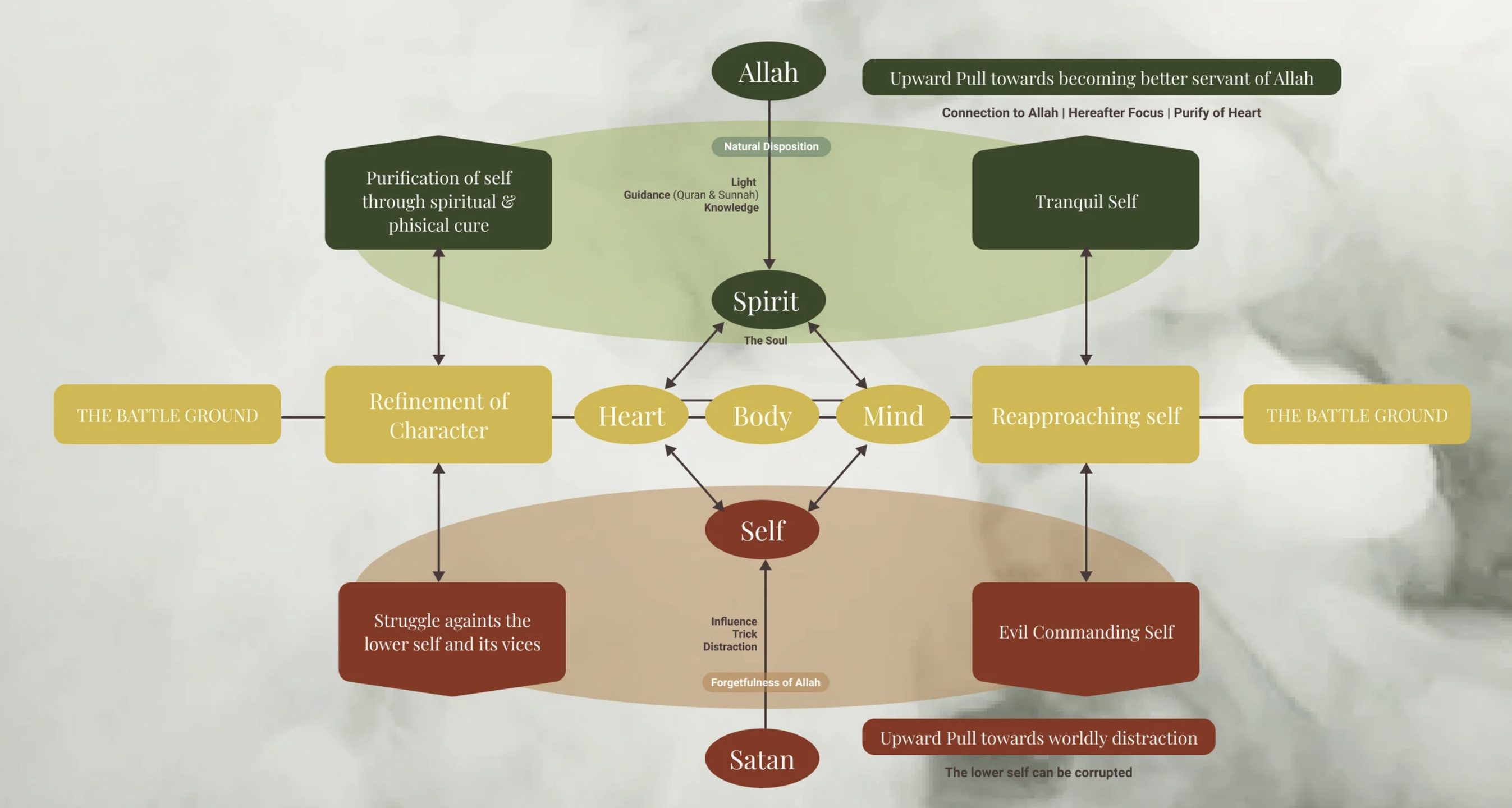
The Science of Intention (Niyya)
"Umar Ibn Al-Khattab relates that he heard the Messenger of Allah (SAW), say, 'Verily actions are by intentions, and for every person is what he intended. So the one whose hijrah was to Allah and His Messenger, then his hijrah was to Allah and His Messenger. And the one whose hijrah was for the world to gain from it, or a woman to marry her, then his hijrah was to what he made hijrah for.'"
Every Muslim knows this hadith, but its deeper meaning is often overlooked!
According to Imam al-Ghazali, quoting the great pious Muslim Sufyan al-Thawri, the early generation of Muslims "learned how to perform intentions for actions in the same way that you learn how to perform the actions themselves."
Today we seem to only focus on doing what is right. But Islam teaches us to intend what is right also! When students of knowledge used to ask the early generation about an action that one can perform constantly for the sake of Allah, they were told to always make an intention for the sake of Allah.
Key Insight
The early Muslims learned the science of crafting intentions as much as they learned how to act. The key is combining the art of crafting an intention with the art of doing the action.
How Intentions Actually Work
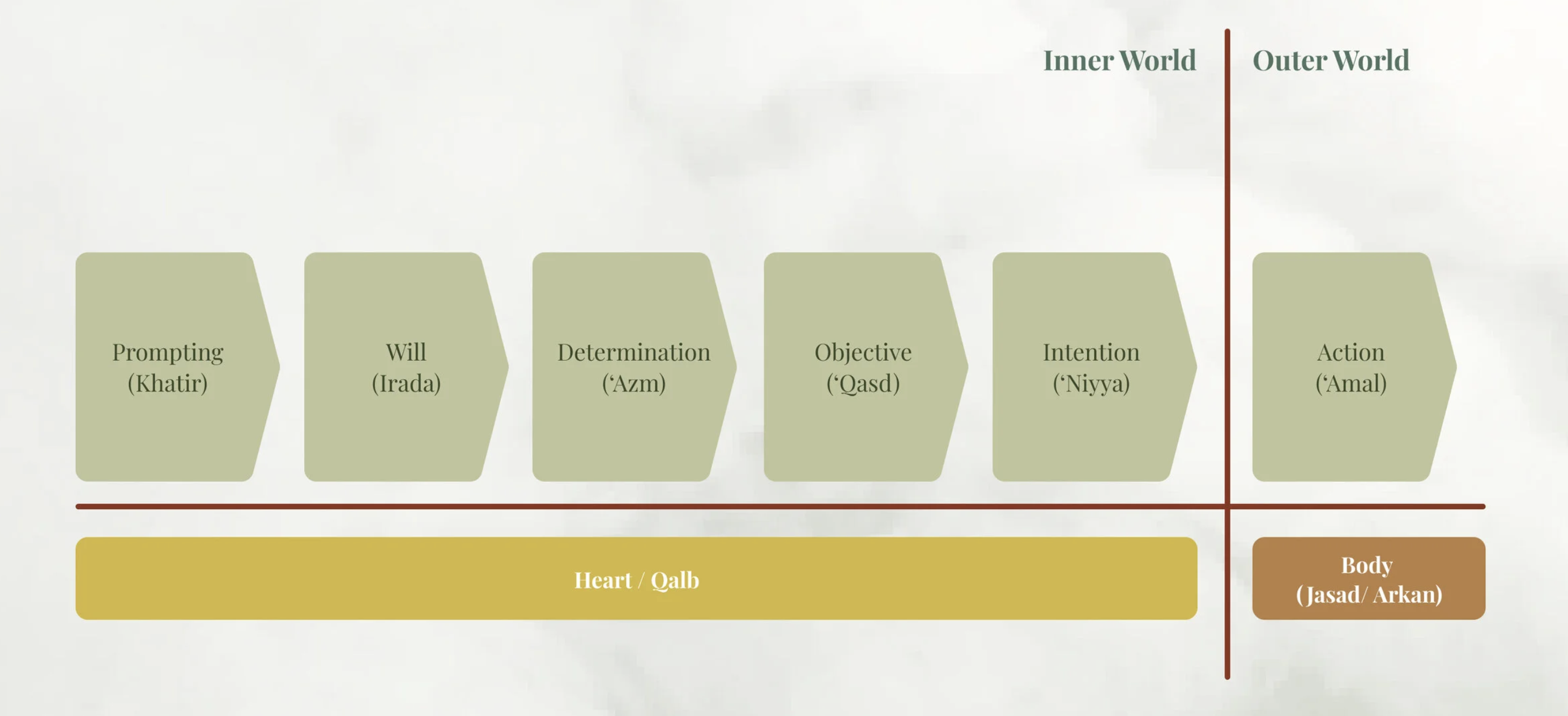
Relation between our Inner Life and Outer life
Look at the diagram above. Intention is something that we do when we are just about to perform an action. It means that an intention happens at the moment that an action is about to be performed. But an intention is the result of a long internal process that begins with what the scholars call a prompting (khatir). What is prompting?
Prompting (Khatir) 💭
A prompting is a faint idea, passing thought, or suggestion that pops into our head quickly and pops out as quickly as it came. It happens extremely fast. We have these 'faint ideas' all the time. A prompting is an urge to do something right or wrong and is characterized by the speed by which it comes to us and leaves us.
Will (Irada) 💪
The scholars teach us that if we think about the prompting or entertain it a little in our mind it transforms into a will (irada) or desire to do it.
Determination ('Azm) 🎯
If we still think about it, it becomes stronger and transforms into a determination ('azm)
Objective (Qasd) 🏆
If we keep pondering upon the determination, and craft a mental plan to do it, then we call it objective (qasd). At this point we have thought about it long enough that it becomes a purposeful thing we intend to do.
Intention (Niyya) ✨
Once the plan and means are decided, the final decision to act upon it is the intention (niyya).
It all starts with a prompting. There are two types of promptings:
Good promptings
Bad promptings
Sources of Promptings
There are five sources of a prompting:
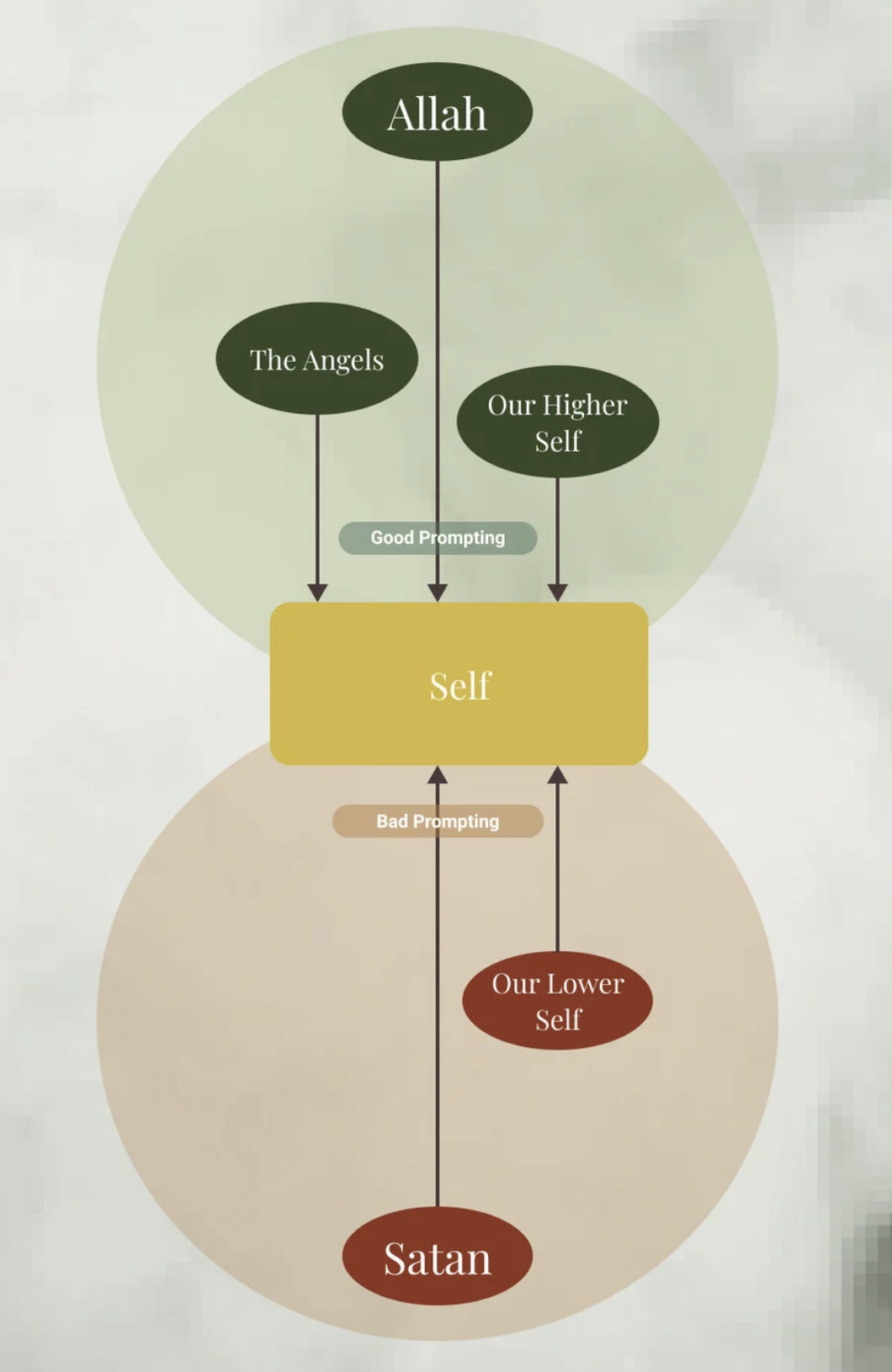
Good promptings come to us either from Allah, the angels, or our higher Self. In either case, we experience an inclination and think of doing something good. It might be the faint suggestion to get up and do fajr early in the morning or the inclination to help someone or forgive them. The scholars tell us that Allah sends his emissaries or ambassadors to suggest good thoughts to us to do good things, these ambassadors are the promptings.
Sometimes bad promptings come to us. These are either from our lower self or shaytan. It might be a faint suggestion to mention something bad about someone to someone else (back biting) or to cheat someone. If we dwell on it and entertain the idea long enough it transforms into an intention to do it. We must not encourage this. We should be able to ward it off as soon as it arrives so that we do not dwell on it. Otherwise, it will transform into an intention to do wrong.
Look at the diagram above again. The scholars teach us that if we think about the prompting or entertain it a little in our mind it transforms into a will (irada) or desire to do it. If we still think about it, it becomes stronger and transforms into a determination ('azm) and then an objective (qasd) or goal. At this point we have thought about it long enough that it becomes a purposeful thing we intend to do. This process is very fast, faster than the blink of an eye sometimes. Hence the importance of cultivating the growth and crystallization of a good intention.
The Seven Amazing Characteristics of Good Intentions ✨
Starts in the Heart ❤️
- Emerges from within you
- Focuses your heart on doing good
- Best reason: for the sake of Allah (li wajhi-llah)
Articulated by the Tongue 🗣️
- Speaking it out loud strengthens it
- Writing it down makes it even stronger
- Try it: verbalize your good intentions!
Confirmed by the Mind 🧠
- Your conscious mind processes it
- Rational decision-making is involved
- You're fully aware of what you're doing
Manifested by the Body 🏃♂️
- You actually DO what you intended
- Action completes the intention
- Talk is cheap, action is everything
Flows Through the Entire Action 🌊
- Like blood flowing through veins
- Like a river flowing through its bed
- The intention is the "spirit" of the action
Preserves You in Purity 🛡️
- Acts like a protective shield
- Keeps negative thoughts away
- If you lose focus, just renew your intention!
Purifies Your Unconscious Mind 🧽
- Sinks deep into your unconscious
- Cleanses negative influences
- Like chlorine purifying a swimming pool
The Life-Changing Power of Intentions 🌟
A Good Intention Reconfigures Your Life 🔄
When you cultivate good intentions:
👥 New people enter your life
💡 New ideas come to mind
🛤️ New paths open up
🎯 New possibilities emerge
It's like being put on a completely new trajectory! 🚀
A Good Intention is Emancipatory 🕊️
Intentions help you:
- Free FROM negative impulses and compulsions
- Free FOR your spiritual journey to Allah
- Reclaim control from unconscious influences
- Exercise your God-given freedom to choose
A Good Intention Brings You Closer to Allah 🕌
Every good intention is a step toward Allah. In a sacred tradition, Allah says:
"I am sitting with the one who remembers Me."
By making a good intention, you've moved toward Allah in the Unseen world, even without physically moving! 🌟
How to Start Your Journey 🚀
Begin with Self-Awareness 🔍
Notice your promptings. Distinguish between good and bad thoughts.
Practice Making Intentions 🎯
Before every action, ask: "Why am I doing this?" Make it for the sake of Allah.
Verbalize Your Intentions 🗣️
Say them out loud. Write them down. Make them concrete.
Follow Through 🏃♂️
Don't just intend, act! Let your intention flow through the entire action.
Reflect and Renew 🔄
Check your intentions regularly. Renew them when you lose focus.
The Bottom Line 💎
The early Muslims learned the science of crafting intentions as much as they learned how to act. The key is combining:
🎯 The art of crafting an intention
🏃♂️ The art of doing the action
When you master both, you unlock the power to:
✨ Purify your soul
🌟 Transform your life
🕌 Draw closer to Allah
🕊️ Find true freedom
Start today. Make one good intention. See what happens. 🌱
Remember: Every journey begins with a single step. Every transformation begins with a single intention. 💫